

He was a pitching stalwart on terrific Oriole teams before a drug habit shattered his life. Click the play button below to hear me read a 2006 article I wrote about his fall.
Sammy Stewart probably would’ve had a long and successful career as a starting pitcher in the major leagues if he’d played for any team other than the Orioles in the late ’70s and ’80s. He forged a 3.47 ERA over eight seasons and 307 appearances in Baltimore, testifying to his ability to get batters out.
Unfortunately, there was no place for him in a starting rotation that featured Jim Palmer, Mike Flanagan, Scott McGregor, Dennis Martinez and Steve Stone, so manager Earl Weaver (and Weaver’s successor, Joe Altobelli) had to invent ways to use him. Stewart wound up as a “Mr. Everything” — long reliever, closer, spot starter.
A tall, broad-shouldered right-hander who thew hard, Stewart fared well in every role.
“That guy had some serious talent,” Rick Dempsey, who caught many of Stewart’s outings, told me years later. “He was so strong, just didn’t care, just give him the ball. You had to love him. It didn’t matter who he was up against. He had no fear. You wish you could teach people to take the mound like Sammy Stewart did. The tougher the hitter, the better he liked it.”
A mop of curly hair and thick mustache gave him a distinct look, more goofy than forbidding, but he was consistently effective in high-pressure situations.
In his major league debut at Memorial Stadium on September 1, 1978, he struck out seven straight White Sox batters to set a record that still stands.
Then, as his role as a late-game specialist evolved, he didn’t blink at coming out of the bullpen to finish what others had started. In the Orioles’ 1979 and 1983 postseason runs, he covered 12 innings combined without allowing a run.
“I had a good arm. God gave me talent,” Stewart told me years later.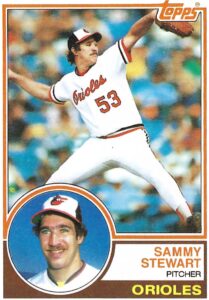
In Game 4 of the 1983 World Series, he relieved starter Storm Davis in the bottom of the sixth inning in Philadelphia with the Orioles having just taken a 4-3 lead. In a tight, tense game, Stewart deftly covered the next seven outs for the Orioles before giving way to Tippy Martinez in the bottom of the eighth. Baltimore won, 5-4, to take a 3-1 lead in the series. They wrapped up the series the next day.
He was a perfect fit for Baltimore in the Memorial Stadium era. He and his wife bought a home and lived in the area; some of the fans cheering for him were his neighbors. Born and raised in Asheville, North Carolina, he had working-class roots and no airs. An inveterate prankster with a devilish grin — one day a coach had to rush to the mound during a game to keep him from flinging a pitch left-handed, which he’d vowed to do — he was beloved by teammates.
The fans rooted especially hard for him after both of his children were born with cystic fibrosis, necessitating constant care at area hospitals.
Ever the workhorse, he covered 222 innings combined in 1984 and 1985 as the Orioles slowly fell from their place among the American League’s elites. It was a surprise when GM Hank Peters traded him to the Red Sox after the 1985 season, receiving infielder Jackie Gutierrez in return.
The Red Sox wound up winning a pennant in 1986, but Stewart was just a bit player in the triumph due to an injury and a feud with the manager. After that season, he signed with the Indians as a free agent but only appeared in 25 games in 1987. Then he abruptly retired at age 32, telling me years later that her made a terrible mistake because he wasn’t done.
Sadly, his post-playing life spiraled into a full-fledged tragedy. Beyond the situation with his children, there’d been little outward sign of trouble in his personal life other than a 1983 drunk-driving incident, but soon after his last major league appearance, he tried crack cocaine at a party and became addicted. Moving his family back to his native Asheville didn’t help, as he’d hoped. His son died at age 11, his addiction worsened and his life fell completely apart.
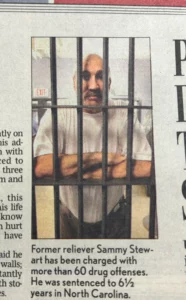
A photo of Stewart accompanying my 2006 article ran on the front page of The Baltimore Sun.
By 2006, according to local police records, he’d been arrested 46 times with more than 60 drug offenses. The Baltimore Sun sent me to Asheville to interview him and write about what had happened to him. The interview took place in prison, with a thick pane of glass between us.
Amiable and contrite, Stewart chronicled the story of his fall. The article I ended up writing was one of the saddest I authored in my 23 years at the paper. Stewart hated it because I spoke to his wife and daughter and their accounts were anything but positive. He wrote me a scathing letter from prison.
(Note from John Eisenberg: To hear my audiobook-style reading of my 2006 Baltimore Sun article about Stewart, click on the play button below.)

Subscribe to The Bird Tapes here: birdtapes.substack.com/subscribe
You’ll receive instant access to vintage audio interviews with Orioles legends, including:
Jon Miller
Davey Johnson
Earl Weaver
Fred Lynn
Al Bumbry
Peter Angelos
Rick Dempsey
Elrod Hendricks
Mike Flanagan
Eddie Murray
Ken Singleton
Brooks Robinson
Frank Robinson
Boog Powell
Cal Ripken, Jr.
Paul Blair
Dennis Martinez
Harry Dalton
Ernie Harwell
And many more to come, added weekly