

Before coming to Baltimore in 1954, the franchise spent 52 years as the St. Louis Browns, mostly languishing near the bottom of the American League. But they weren’t boring. And they aren’t forgotten.
While watching an Orioles game on MASN earlier this year, I spotted in the crowd a fan with either a sense of humor or a sense of history. Or maybe both.
On a chilly day at the White Sox’s ballpark in Chicago, he was wearing a St. Louis Browns sweatshirt — an obscure and ironic but wholly accurate way to show support for Baltimore’s baseball team.
Confused? No worries, there’s a simple explanation.
Before the major league franchise known as the Orioles launched in Baltimore in 1954, it spent 52 years in St. Louis as a team called the Browns.
You can look it up, as Casey Stengel used to say. The Orioles’ team page on pro-baseball-reference.com covers the franchise’s 126 seasons of baseball — 73 in Baltimore preceded by 52 in St. Louis and one season in Milwaukee at the dawn of the American League in 1901.
The St. Louis era was mostly forgettable, at least in terms of wins and losses. The Browns finished more than a thousand games under .500 over 52 years – do the math, ouch. They won just one pennant, in 1944, when many of baseball’s best players were off fighting World War II.
But while the Browns are long gone, they aren’t forgotten. Far from it. Just ask anyone connected with the St. Louis Browns Historical Society and Fan Club.
A thriving organization, it operates a website, publishes a newsletter, stages roundtables and hosts an annual luncheon in St. Louis that 300 to 400 fans attend. The Gateway Grizzlies, a minor league team in the area, hosts a St. Louis Browns Night with the teams wearing replicas jerseys.
Just how big is the historical society and fan club devoted to a major league team that hasn’t played since 1953?
“Seven hundred to a thousand people participate all year. There are around 450 diehards,” said Ed Wheatley, president of the organization.
What’s the goal? Here’s a quote straight from the organization’s website:
“Misfits, a midget and money problems. The Browns are baseball’s losingest and least-remembered team. But beneath that tarnish is pure baseball gold. Heroes of the greatest generation. Moments of grit, guts and glory. A roller coaster of ruin and redemption. The St. Louis Browns Historical Society and Fan Club is dedicated to preserving every stat and story so the legend of baseball’s most colorful underdogs can endure forever.”
Yes, that team of “misfits, a midget and money problems” morphed into the Baltimore Orioles.
It occurred to me that the Bird Tapes, a project dedicated to Orioles history, is incomplete without what certainly qualifies as the prequel — the story of what happened in St. Louis and what caused the Browns to pack up and head east.
The latest episode of the Bird Tapes Podcast, available at the bottom of this post, contains my interview with Wheatley, the best possible choice to guide us through the mostly tortured tale of Browns history and the franchise’s eventual move to Baltimore.
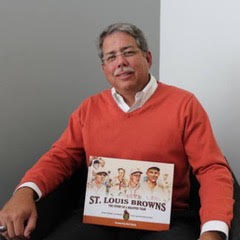
Ed Wheatley with a copy of a book on the Browns published in 2017.
During our conversation, Wheatley covered the highlights — the career of George Sisler, the Browns’ greatest player, a lifetime .340 hitter; the pennant-winning season of 1944; the club’s winning run through the Roaring Twenties; and most famously, the day in 1951 when 3-foot-7 Eddie Gaedel stepped to the plate and drew a walk.
It’s all time-capsule stuff from the distant decades when there were just 16 major league teams, many of which shared their hometown with a team in the other league. Philadelphia, Boston, New York, Chicago and St. Louis all had teams in both the American League and National League.
The Browns’ crosstown rivals were the far more successful Cardinals. But incredibly in hindsight, it was the Browns, not the Cardinals, who owned Sportsman’s Park, the ballpark where both teams played. The Cardinals were tenants. And the city was split fairly evenly in terms of fan support. The Cardinals played better baseball, but the Browns put a one-armed player in the outfield, let their fans make managerial decisions and sent a midget up to bat. You never knew what was going to happen.
Most interesting to my Baltimore ears during our conversation were the events Wheatley described that could have altered the Browns’ fate and resulted in them NOT moving to Baltimore in 1954.
Yes, it was possible.
Consider:
- Before the legendary Branch Rickey turned the Cardinals and Dodgers into winners, he ran the Browns’ front office in the 1920s. Imagine if he’d stayed and deployed his many innovations for their betterment.
- In 1940, the Browns’ ownership was set to move the club to Los Angeles. Pearl Harbor intervened.
- In the early 1950s, shortly before then-owner Bill Veeck sold the team to Baltimore interests, he explored moving the club to Milwaukee. The Boston Braves beat him to it.
What if the Browns had NOT moved to Baltimore? It’s inconceivable now, but it’s a fair question when you dig into Browns history.
After the Browns did move to Baltimore, all traces of them pretty much vanished. Baltimore’s owners wanted nothing to do with anything that had happened in St Louis, resulting in a complete scrubbing of Browns history from the Orioles’ annals — a sore subject among some of those who treasure the Browns.
Undeterred, the St. Louis Browns Historical Society and Fan Club continues to show unabashed love more than 70 years after the club’s demise. In the past decade, it has published a new book on the Browns, helped produce a documentary narrated by actor Jon Hamm, a St. Louis native, and helped convince the Missouri Sports Hall of Fame to induct the Browns in 2018.
“We’re very, very active,” Wheatley said.
Long gone … but not forgotten.
Again, this episode of the Bird Tapes Podcast is available below.
If it encourages you to follow the lead of the fan I saw on TV and buy some Browns gear, well, have at it.

Subscribe to The Bird Tapes here: birdtapes.substack.com/subscribe
You’ll receive instant access to vintage audio interviews with Orioles legends, including:
Jon Miller
Davey Johnson
Earl Weaver
Fred Lynn
Al Bumbry
Peter Angelos
Rick Dempsey
Elrod Hendricks
Mike Flanagan
Eddie Murray
Ken Singleton
Brooks Robinson
Frank Robinson
Boog Powell
Cal Ripken, Jr.
Paul Blair
Dennis Martinez
Harry Dalton
Ernie Harwell
And many more to come, added weekly