

(Note from John Eisenberg: I’ve been fortunate to travel on two different rails as a writer, publishing 11 nonfiction books, each of which took years to complete, but also thousands of newspaper and website columns, articles and features, almost all authored quickly, on tight deadlines. Along the way I’ve also written some material that didn’t quite belong on either rail. In 2012, my son was playing college baseball and I began to write about what I was seeing and my family’s history with baseball. I had to abandon the project when the Baltimore Ravens hired me to write columns for their website. But I recently reviewed what I’d written and thought the Bird Tapes community would enjoy it. It isn’t about Orioles history, but it’s about baseball and memories, which is the essence of the Bird Tapes. I’ve done some editing and updating and I’m publishing the piece in two parts this week. If you missed Part 1, you can click here to read it.
When my son, Wick Eisenberg, was finishing up high school in 2009, he wanted to keep playing baseball in college. And he could.
His grandfather — my dad — had excelled as a short fielder on a championship medical-school softball team in the ’40s, but he never played more than sandlot baseball. My playing career peaked in sixth grade. Fortunately, Wick had more size than either of us thanks to his mother’s family’s genetic influence, and he also had more baseball ability. A left-handed pitcher, he won 20 games in high school, made All-City and spent his summers gaining experience against quality competition.
Although he lacked the eye-popping oomph on his fastball that most recruiters in the NCAA’s elite Division I want, he kept hitters off-balance with good control and a looping curveball. After one of his high school outings, the coach of a lesser Division I team sought me out on the sidelines.
“You’re the lefthander’s dad?” he asked.
He gave me a business card. Wick was flattered by the D-1 interest. But the school didn’t interest him.
The NCAA’s Division III was more his style. Smaller schools and smaller classes. No athletic scholarships. A range of academic standards and also a range of takes on playing to win, i.e., some programs cared a lot more than others.
Recruiting in D-3 is nothing like the flesh peddle of D-1. It starts with a series of tangos. A coach hears about a player through the high school grapevine, or scouts him at a summer showcase, or sees a video of him and sends a letter or email indicating possible interest. The player either responds or doesn’t, nothing personal. If it feels like a possible match, a visit is arranged so everyone can look each other over as transcripts are examined, talent evaluated, finances considered, and academic scholarship money occasionally dangled. Admissions offices eventually weigh in, the player surveys his options, and a decision is made.
We took some basic steps to get Wick noticed. DIY’d a video of him pitching and sent it around. Sent him to a D-3 showcase in Virginia. His talent, record, grades, and the plus of being left-handed turned him into at least a minor commodity. He heard from more than a dozen D-3 programs.
As he sorted through deciding where to apply, he wanted a school with good academics, but he also wanted the right place to keep playing the game he’d loved since he was a kid lobbing pitches toward home plate. The baseball fit mattered. He’d put in a lot of time.
We visited a half-dozen schools. The coach of a baseball powerhouse in Ohio resembled a central-casting mob boss with his florid complexion, lacquered nails and heh-heh smugness. He smiled thinly at Wick, who was 6-feet-2 and broad-shouldered but still wore glasses and so resembled the lead character in the Harry Potter movies that he’d never played on a team where he wasn’t known as “Harry.”
The coach sat behind his desk, a row of trophies glistening on a shelf behind him. “I looked at your video. I’ve seen better. Tell me why I should want you,” he said.
Wick tried to sell himself, eventually applied to the school and was admitted, but it seemed he would not have played much, if any, and a wise head in such matters advised him, “You definitely don’t want to go where the coach looks at you at the first team meeting in the fall and says, ‘Oh, yeah, now, what’s your name?’”
The coach at another college in Ohio, one with exceedingly tough entrance standards, really pursued him, sending letters and emails before and after he visited; one email was a faux game report from the school’s sports information office containing an account of a fictional complete game Wick had pitched. But it all became moot when he landed on the waitlist.
I took him to visit a college in northwest Pennsylvania in January of his senior year; the coach had called several times and the school had solid academics. The coach turned out to be young, earnest, and energetic; there was little doubt he would put a winner on the field. But for some reason, near the end of our visit he thought it was a good idea to take us to see the baseball field. There was a foot of snow on the ground, and more fell as we stood by the dugout, feigning excitement. The distant outfield resembled the backdrop from the opening scene of “Fargo,” a bleak and forbidding winterscape. If a centerfielder wandered out there now, he might never return.
Within minutes of leaving the campus, Wick’s cell phone rang. It was the pitching coach from St. Mary’s College of Maryland, who had been recruiting him with several calls per week.
“It’s 55 degrees here! We’re practicing on the field today!” the coach said brightly.
Wick’s decision began to take shape with that call. His visit to St. Mary’s, a liberal arts college near the tip of southern Maryland, went well. He had played high school ball against several players on the team. They encouraged him to come. The academics were a fit, the campus irresistible. The coach, Lew Jenkins, was a grandfatherly egalitarian.
“I’m looking at a bunch of schools,” Wick told Lew.
“As well you should,” Lew replied, offering not a hint of the hard sell. “We would like to see you here but you decide what’s best for you.”
Wick deduced that they would know his name at the first team meeting if he came. The Seahawks had gone without a left-handed pitcher for two years. They were not a winning team, but they needed him.
He made his decision in the spring. He would be a Seahawk.
The Seahawks belonged to the Capital Athletic Conference, a seven-team circuit completely dominated by the Seagulls of Salisbury University. They were the Yankees and Red Sox rolled into one, a national power. Salisbury players battled for roster spots, playing time and possibly getting cut – a more pointed approach than Lew’s, to say the least. A Salisbury coach had called Wick to see if he was interested, but it sounded like an intense environment and he declined, consigning himself to bowing in submission as he watched Salisbury dominate their league every year.
The other teams in the conference – York College, Wesley College, Frostburg State, Mary Washington University, and Stevenson University as well as St. Mary’s – all basically competed for the No. 2 spot, hoping Salisbury might improbably stumble. The chances were slim, but the Seahawks had high hopes as the 2012 season began. They had most of their players back from a team had finished 2011 with a 19-17 record, just their second winning mark of the past decade, and Lew had brought in several transfers to further bolster the lineup, including a shortstop with a potent bat and a mountainous designated hitter. Things seemed to be moving in the right direction. If a few bounces went their way, maybe the Seahawks could win 20 games and contend for a spot in the NCAA tournament.
Now a junior, Wick was moving into the starting rotation. He’d served as the closer the year before and saved a handful of games, but it was time for him to shoulder a heavier load. Lew had given him several starts along the way, including one in the conference tournament in which he limited a hard-hitting opponent to a single run over six innings and left with a lead, only to see a senior reliever blow it.
The Seahawks opened the 2012 season with the series at Randolph-Macon that I began Part 1 with, the series that was mostly wiped out by snow and cold. But they did get in the first game of the opening doubleheader before snow began to fall. They trailed early, staged a late rally, and Wick was summoned from the bullpen with the score tied in the bottom of the seventh. (It was a seven-inning game as part of a doubleheader.) Although he was a starter now, he wouldn’t make his first start for another week and was needed now.
He had fared well in such tense situations the year before; when the damsel was tied to the tracks, the train was coming, and everyone else looked away to avoid witnessing the disaster, he tended to throw strikes and wiggle out of danger. He didn’t appear nervous now as he trotted in from the bullpen wearing gray pants, a blue jersey with number 29 on the back over a blue turtleneck, and a blue cap with the Seahawks logo on the front.
But there was a chance he might be rusty.
He had spent the fall semester studying in England, missing a slate of “fall ball” practices. (One of the beauties of Division III: academic opportunities such as a semester abroad actually are encouraged even if your game suffers.) He had taken his glove with him to England, thinking he might occasionally throw to keep his arm in shape, but the only time he’d picked up a ball was during a walk in Hyde Park when he came across some Japanese high schoolers practicing baseball in khakis. Wearing his Seahawks satin jacket, he watched from a distance, unable to suppress a smile, then stepped in and showed the pitchers how to throw a curveball. The coach invited him to come back anytime, but between taking theater and literature classes and finagling his way into Premier League soccer matches, he never had the time.
Now, after returning to the States and practicing for just a few weeks, he was on the mound with a game on the line. Perhaps not surprisingly, the first Randolph-Macon batter blasted a hanging curveball between the centerfielder and rightfielder for a triple, the ball rolling to the wall as the bundled-up parents on their side cheered. The winning run suddenly was 90 feet from home. Welcome back, Wick.
But just as he had the year before, he bore down and escaped the jam without allowing a run, retiring the next three batters on a strikeout, popout, and groundout. His teammates burst from the dugout excitedly as he strode toward them, having saved the day again.
But it wasn’t his day in the end. He gave up another triple and the winning run in the bottom of the eighth, and an hour later, the snow squall blew in.
A week later, the Seahawks opened their home season with a weekend series against City College of New York, a team known as the Beavers, or los Castors to the infielders from the Bronx who chattered with each other in Spanish. Their coach had brought them south to play in “warmer” weather, having surely tired of working out in a gym in New York. When they piled off their bus in southern Maryland after a five-hour drive, hunched in heavy coats over their bright purple jerseys, they found a blanket of gray clouds hanging low in the sky and a chilling wind knifing off the St. Mary’s River. But with the bar for acceptable playing weather astoundingly low, the sheer absence of snow meant the games were on.
The Seahawks’ home park, known as the Hawks Nest, is a serene idyll Henry David Thoreau would have enjoyed, essentially a manicured clearing surrounded by a thick forest of tall pines on three sides. If not for a 50-foot-high screen that surrounds every part of it except the outfield, dozens of foul balls would get whacked deep into the woods during every game. There are critters back in there, for sure; sometimes you hear strange pealing sounds in the lulls between innings.
The field’s pioneer-style dugouts are fashioned from thick logs and wooden planks. Gulls circle overhead. The old-timey earthiness is interrupted only by a bank of aluminum bleachers by the home dugout, which many fans eschew, preferring to perch in canvas folding chairs on a grassy knoll overlooking the third-base line.
With Wick scheduled to start the second game of Saturday’s doubleheader against CCNY, my wife and I made the 100-mile drive down from Baltimore, trekking through the bedroom suburbs west of Washington D.C. and into the rolling farmland of southern Maryland. You’re getting close when you rise up and over the soaring bridge at Solomon’s Island, seemingly taking an elevator to the clouds, and then go past the Patuxent Naval Air Station, with its rows of forbidding bombers parked by the road for show. We had our dog in tow, a miniature schnauzer, as well as a tin of mom-baked cookies.
As we strode from the parking lot toward the field, bundled in jackets and toting canvas chairs, blankets, lunch and the dog, Wick pulled away from his warmups to greet us, trotting around the outskirts of the field for hugs behind the plate. Lew does not lord sternly over the pregame scene; if you want to go pet your dog, you can. But Wick left quickly. As the second-game starter, he would chart pitches during the first game, hopefully picking up tips on how to attack the Beavers’ hitters.
Since the first game was the Seahawks’ home opener, the school’s president threw out a ceremonial first pitch. Smiling and dapper with an English department background, he’d come to practice a day earlier to limber up his arm, and it paid off – he zinged a strike to the catcher as a chorus of good-natured whoops arose from the bleachers, which were surprisingly nearly full of students, mostly young women.
The Seahawks jumped ahead in the bottom of the first when the new shortstop slapped a double, knocking in a pair of runs. A student manning a public address system introduced the players before they batted while playing the “walk up music” each had carefully selected as their imprimatur — mostly rap and hip-hop, with a bit of country mixed in. Most of the cheering came from the players in the dugouts. The parents on the hill clapped politely. A row of dads watched gravely from up close, hanging on the fence by the dugout. The young women on hand – girlfriends, it seemed – talked quietly to each other and even put their noses in textbooks until their boyfriends strode to the plate, bats in hand.
“Come on, Stefano!!” one abruptly screamed as her seatmates giggled.
With the Beavers flailing at the sinking fastballs of the St. Mary’s starter, a power righty, the outcome was never in doubt. The Seahawks won, 6-1, and then it was time for lunch, a between-games ritual as hidebound as the tea break that halts cricket matches in England. The second game would start in a half-hour.
The parents of the Seahawk players were in charge of feeding the players and coaches on both teams – over 60 meals. It was all planned weeks ahead of time amid a flurry of emails and phone calls familiar to any sports parent. Someone agrees to provide the main course, usually either Subway or hot pulled pork sandwiches. Someone brings fruit. Others sign up for drinks, chips, and dessert. The ringmaster brings a table to spread the buffet on, as well as a grill if needed. There are young bellies to fill and another game to play. The pressure is on. Everything needs to unfold hitch-free and in a hurry. It could be a Food Channel reality show.
As the second-game starter, Wick was allowed to eat late in the first game; he would be warming up while everyone else ate during the break. The lunch line opened for business, and he grabbed a pork sandwich and chips and toted them back into the dugout, presumably charting the final inning between bites. Then he headed out to the field to limber up with some jogging, long-tossing with his catcher, and a session on the bullpen mound, located next to the parking lot behind right field.
The other players moved through the buffet line and found places to sit, balancing their plates on their laps while they ate and chatted with each other or their parents and/or girlfriends. Then they stood, stretched, dusted crumbs off their uniforms, and returned to the field to warm up. How they could play with a meal in their bellies was beyond me.
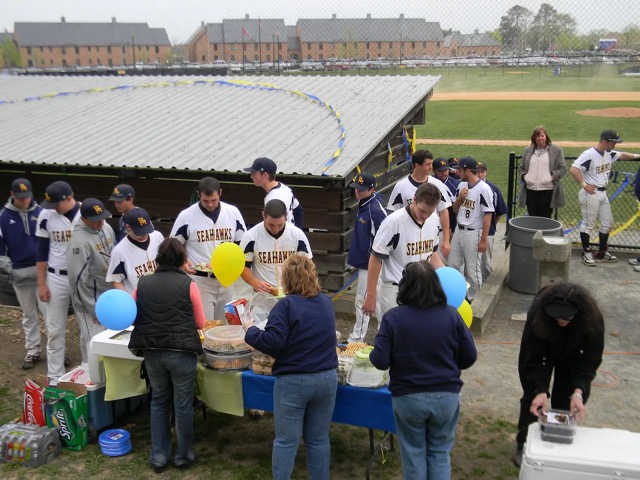
Lunch between games. A big deal.
A slanting sun was poking in and out of the clouds when Wick tossed the first pitch of the second game – a fastball, low. This was his debut as a bona fide member of the rotation, and I knew he wanted to perform well, demonstrating that the promotion was warranted.
He gave up a hit but no runs in the top of the first, and the Seahawks went ahead with a run in the bottom of the inning. But in the top of the second, an outfielder dropped a line drive and Wick gave up a couple of hits, resulting in two unearned runs. The umpire wasn’t giving him the low strike he lived on, and his curveball was coming in high, putting him behind in counts – never where a control pitcher wants to be.
The Beavers made it 3-1 in the top of the third on a single and a double. Normally efficient, Wick was struggling, his pitch count rising, runners seemingly always on. But then he found his stride after the Seahawks tied it up in the bottom of the third, retiring the side in order in the fourth and also getting the first two batters in the fifth. Just when he seemed in control, though, one strike away from finishing a second straight clean inning, he gave up a pair of hits that produced a run. A reliever replaced him to start the sixth.
The Seahawks wound up winning, but Wick wasn’t satisfied with a no-decision against a weak opponent. (The Beavers would lose 16 straight games before securing their first win of 2012.) A run with the dog after the game helped his mood, and we took him to dinner at the Olive Garden by the naval base, one of the local standards for a nice night out. We talked about his classes more than his pitching, which, we knew, had disappointed him.
During the meal I expressed concern about the next day’s scheduled high-noon start for the final game of the CCNY series, remembering well from my college days that Saturday nights tended to bleed into Sundays that started bleary. Wick had told us about a teammate whacking a triple while still recovering from the night before. These were not soldiers of the Division I grind, under the thumb of coaches and scouts scrutinizing their every move. These were typical college kids unashamedly wanting their party nights as well as their baseball days.
“But we’re following the 24-hour rule this year,” Wick explained earnestly.
The 24-hour rule?
“No drinking 24 hours before a game,” he said. “We’re trying to be good about it. We’ll see how long that lasts.”
Here’s an epilogue, written in 2026 after I looked back at what I wrote 14 years ago:
It turned out the Seahawks didn’t fare well in either of Wick’s final two years at St. Mary’s. They lost many more games than they won and finished near the bottom of the CAC standings. Wick won a few games as a starting pitcher, including a complete-game gem against a tough opponent in his final home appearance. He was the team captain as a senior, a testament to how he’d carried himself. But he lost more games than he won and it wore on him. After the final start of his senior season went awry, he walked off the field. I had driven down to watch, knowing this probably was it for his college career. He looked at me and said, “I’m tired. My arm hurts.”
He was ready to stop being a pitcher.
It had been a big part of his life since he was 7, but he was 21 now and ready to move on, even with the solemnities of adulthood now right in front of him — choosing a career, making a living, paying taxes, etc. I think it’s a typical evolution for many young athletes. When they’re young, they find a sport they love and devote hundreds of hours to it, to the point that it becomes who they are, in a sense. But as they mature, they discover they like other things in life just as much, if not more, and their beloved sport begins to recede in their priorities. It’s called growing up.
Wick loved his college years because he made great, lifelong friends, relished living on a gorgeous campus by a river, took interesting classes (like the one in which the entire semester consisted of reading War and Peace) and because he played baseball — in that order, I would say.
Wick’s older sister, Anna, had a similar experience. She played softball every year, through rec and into high school. Also a pitcher, she was determined enough to spend some winter nights firing balls at a clinic in a musty gym. But while she logged her share of innings on the mound, her academics eventually became her priority.
Years later, I can state with assuredness that my wife and I are incredibly fortunate. Both of our children, Anna and Wick, are now in their mid-30s and happily married, headlong into their working careers and living within 15 minutes of us in Baltimore. Our immediate family has grown into a grand party of eight, including the three couples and two grandchildren (and three dogs). We take a vacation together every summer. And while years have passed since Anna and Wick played, baseball is still their favorite sport, easily, just as it was when they were young.
On the September night in 2014 when the Orioles clinched the AL East title at Camden Yards, I was watching on television at home when my phone buzzed with an incoming text. Anna and her fiancee, soon to be married, had made the impromptu decision to attend the game and witness a celebration that, they knew, should be treasured. I could only smile at the role reversal. Forever, it seemed, I’d been the one at the ballpark, texting out thoughts to family members watching at home. Now, I was watching at home and they were at the ballpark. And to be clear about a distinction, I was there for work all those years, and they were there out of love for the team.
Today, a dozen years after that night in 2014, Anna and her husband have a house and kids and a sign hanging in their front entryway that reads, “We interrupt this marriage to bring you baseball season.” Their kids have seen the Orioles play at Camden Yards and on family trips to Sarasota for spring training. Our family’s next generation of fans is already coming along. My grandson shook hands with Larry Sheets one night at the ballpark. If that doesn’t hook you, what will?
If their beloved Orioles ever make it to the World Series for the first time since before they were born, both of my kids would surely shed tears.
I guess we raised them right.
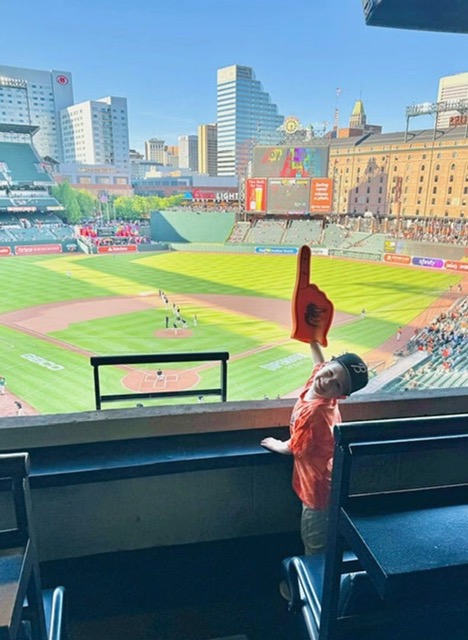
My grandson, already a fan.

Subscribe to The Bird Tapes here: birdtapes.substack.com/subscribe
You’ll receive instant access to vintage audio interviews with Orioles legends, including:
Jon Miller
Davey Johnson
Earl Weaver
Fred Lynn
Al Bumbry
Peter Angelos
Rick Dempsey
Elrod Hendricks
Mike Flanagan
Eddie Murray
Ken Singleton
Brooks Robinson
Frank Robinson
Boog Powell
Cal Ripken, Jr.
Paul Blair
Dennis Martinez
Harry Dalton
Ernie Harwell
And many more to come, added weekly